It’s possible that a nonsurgical root canal procedure won’t be enough to save your tooth and that your endodontist will recommend surgery. Endodontic surgery can be used to locate small fractures or hidden canals previously undetected on X-rays during the initial treatment. Surgery may also be needed to remove calcium deposits in root canals, or to treat damaged root surfaces or the surrounding bone of the tooth.
There’s no need to worry about surgery if your endodontist prescribes this additional measure. Advanced technologies like digital imaging and operating microscopes allow these procedures to be performed quickly, comfortably and successfully.
Apicoectomy: Saving Teeth Through Microsurgery
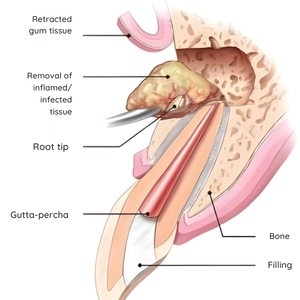
There are many surgical procedures that can be performed to save a tooth. The most common is called an apicoectomy, or root-end resection, which may be needed when inflammation or infection persists in the bony area around the end of your tooth after a root canal procedure.
Your endodontist performs this micro surgical procedure first making you comfortable by applying local anesthesia before opening the gum tissue near the tooth to see the underlying bone and to remove any inflamed or infected tissue. The very end of the root is also removed. A small filling may be placed to seal the end of the root canal and a few stitches or sutures are placed to help the tissue heal. In the next few months, the bone will heal around the end of the root. Most patients return to their normal activities the next day. Post-surgical discomfort is generally mild.
Frequently asked questions about
Endodontic Surgery or Apicoectomy
Will the procedure hurt?
Local anesthesia keeps the procedure comfortable, but it’s normal to have mild soreness or slight swelling as the area heals. Take any recommended pain medicine as directed, follow your post-op instructions, and call your endodontist if pain isn’t improving or doesn’t respond to medication
When can I return to my normal activities?
Most people can get back to work and normal routines the next day. Your endodontist will let you know what to expect for your specific recovery.
Are there other types of endodontic surgery?
Yes. Depending on the tooth and the problem, an endodontist may recommend procedures such as repairing an injured root or selectively removing part of a tooth’s root to help preserve the rest of the tooth. In certain complex cases, intentional replantation may be an option—where the tooth is gently removed, treated outside the mouth, and then placed back into its socket. These procedures are done with the goal of saving your natural tooth whenever possible.
Serving Bedford, NH & nearby communities
We’re proud to care for patients in Bedford and surrounding communities in southern New Hampshire
We are located in Bedford, New Hampshire. Visit us at 206 Riverway Place, just off Route 3. You’ll find us in a professional office setting with plenty of free parking available.
206 Riverway Place, Building 2 Bedford, NH. 03110
Monday - Friday: 9 AM - 6 PM Saturday: appointment only